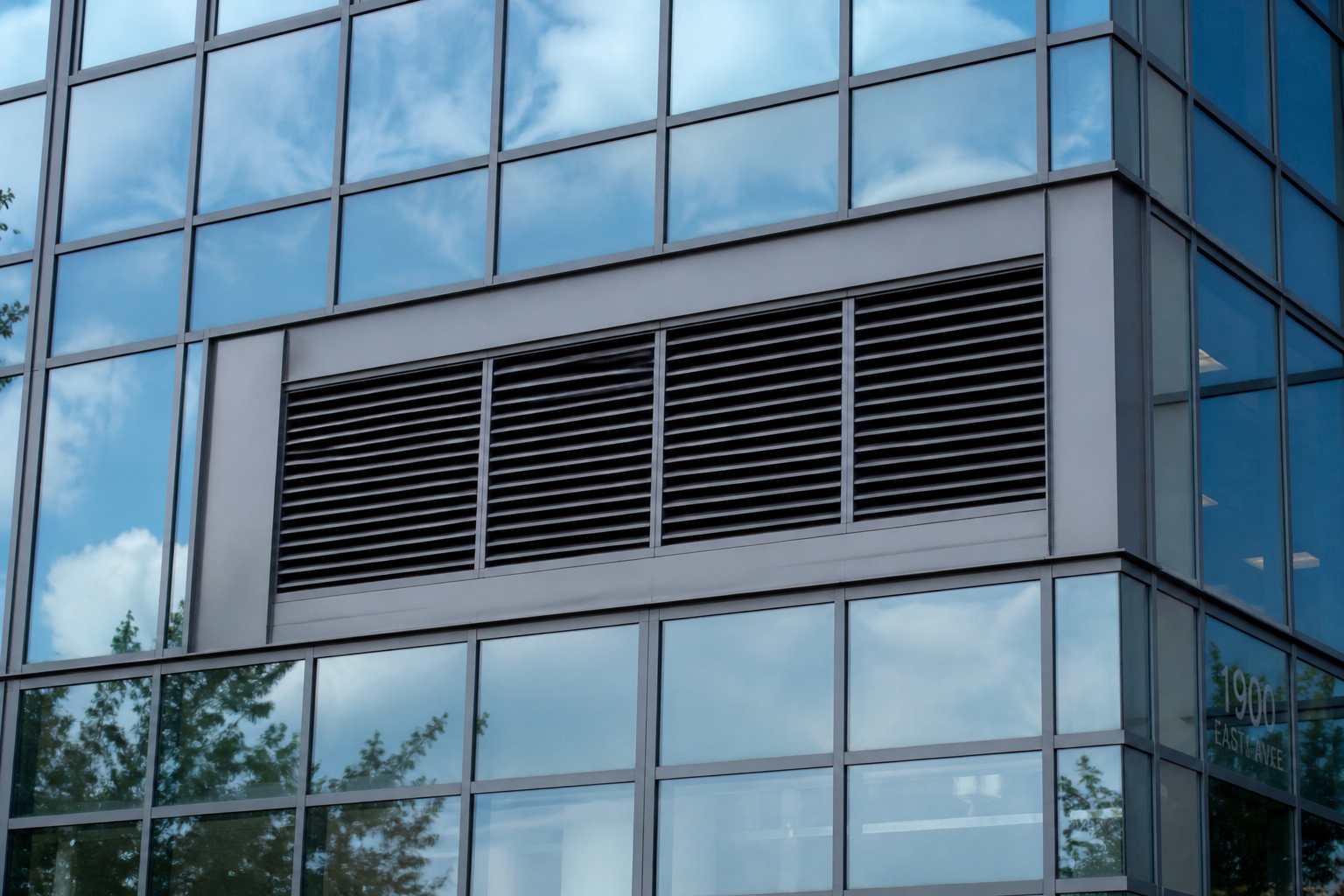
Curtain Wall Louvers: Performance, Integration, And Specification Guidance
Curtain wall systems define how modern buildings manage light, air, weather, and visual identity. Within those systems, ventilation cannot be treated as an afterthought or handled through ad-hoc penetrations without consequences for performance and appearance. A curtain wall louver addresses that constraint by providing a controlled opening within the curtain wall assembly that allows air movement while maintaining alignment with the façade’s structural, aesthetic, and environmental requirements.
What A Curtain Wall Louver Is Within A Façade System
A curtain wall louver functions as a façade component rather than a standalone vent. It replaces or supplements a portion of the curtain wall infill with a framed assembly that contains fixed blades. Planning these openings within the curtain wall layout allows ventilation elements to align with mullions and transoms, preserving load transfer paths and ensuring that water management strategies remain continuous across adjacent materials.
Because curtain walls rely on precise coordination between components, any louver introduced into the system must be designed with the same attention given to glazing units, spandrel panels, and framing members. Treating these assemblies as system components—rather than late-stage inserts—reduces risk at the interfaces where performance problems tend to surface.
How Ventilated Infill Sections Integrate With Mullions And Transoms
Integration begins at the framing level, where mullions and transoms establish the grid supporting glass, metal panels, and louver assemblies alike. A properly coordinated curtain wall louver is sized to fit these openings so anchorage, gasketing, and flashing details align with surrounding components.
When coordination occurs early, air and water barriers stay continuous. When it does not, problems surface at the interface—compressed gaskets, interrupted drainage planes, and increased leakage risk. These outcomes are avoidable when dimensions, frames, and attachment points are resolved alongside the curtain wall package.
Functional Roles Beyond Basic Ventilation
In contemporary commercial and institutional buildings, ventilated infill sections integrated into curtain wall systems serve roles that extend beyond basic ventilation. They influence façade pressure behavior by altering free area and airflow paths, manage exposure to wind-driven rain, and shape how mechanical zones, parking levels, or equipment floors relate visually to adjacent glazing and panelized areas.
Because these roles are interconnected, performance depends on blade geometry, spacing, and depth. Those characteristics determine airflow volume and how air behaves once it reaches the interior, particularly in spaces relying on passive ventilation strategies.
Performance Considerations: Airflow, Rain, And Pressure
Performance in curtain wall applications is shaped by how louvers respond to environmental exposure and how those responses are verified under test conditions that approximate real-world forces.
Wind Exposure And Blade Performance
Weather exposure raises the stakes, especially where pressure and orientation work against the opening. Wind-driven rain challenges any façade penetration, particularly in tall buildings or regions subject to frequent storms. Louvers designed for curtain wall systems rely on blade profiles and internal baffles to shed water while permitting airflow, but effectiveness varies with orientation and detailing at the frame interface.
Tested Ratings And Field Conditions
As wind pressures increase with height and exposure, these conditions become more critical. Systems evaluated under standards such as AMCA 540 for wind-driven rain and AMCA 550 for high-velocity airflow provide documented thresholds that help specifiers assess risk. In hurricane-prone or coastal regions, these ratings help establish tested performance thresholds for airflow and water resistance, provided the louver is installed in accordance with the tested configuration and exposure conditions.
Field performance ultimately depends on installation quality, surrounding façade detailing, and how closely project conditions match the tested orientation and pressure profile.
Fixed Versus Operable Louver Configurations
Fixed and operable configurations represent two approaches to airflow control. Fixed assemblies support consistent ventilation where conditions remain stable and reduce mechanical maintenance demands by eliminating moving parts, though exposure, access conditions, and environmental loading still influence long-term service needs. Operable systems introduce adjustability to respond to changing operational needs, yet they also introduce components that affect access, controls integration, and long-term service.
Selection depends on how the space is used and how much variability the ventilation strategy requires. In both cases, coordination with the curtain wall system governs long-term performance.
Material And Finish Selection For Durability
Material selection balances appearance with durability. Aluminum is commonly used for louver systems in curtain wall applications due to its strength-to-weight ratio, corrosion resistance, and compatibility with curtain wall framing systems. High-performance coatings and anodized finishes extend service life and help maintain visual consistency across the façade, particularly in exposed environments.
Finish selection should account for exposure, maintenance access, and desired service life to avoid premature degradation or color mismatch.
Common Applications In Commercial And Institutional Buildings
Ventilated façade assemblies appear across a range of building types and functions. Mechanical floors use these assemblies to provide intake and exhaust air while concealing equipment behind a unified façade. Parking structures rely on passive airflow openings that remove exhaust without extensive mechanical systems. Equipment rooms and service areas use ventilated façade sections to maintain airflow while preserving façade continuity across occupied and unoccupied zones.
Installation And Coordination Risks To Address Early
Installation and coordination risks emerge in the field when these components are treated like generic inserts. Misalignment with curtain wall framing can interrupt drainage paths or compress gaskets unevenly, leading to leakage or visual inconsistency. Addressing these interfaces during design reduces field adjustments and helps the completed façade perform as intended.
Selection Guidance For Architects And Specifiers
Selection should begin with exposure and performance requirements. Airflow targets, wind pressures, and rain exposure establish the baseline. From there, blade configuration, materials, and framing details can be evaluated in the context of the curtain wall system as a whole.
Early collaboration between façade consultants, louver manufacturers, and curtain wall suppliers helps resolve interfaces before fabrication begins, reducing downstream risk and rework.
Air Performance Louver Solutions For Curtain Wall Systems
Air Performance’s offerings reflect a system-based approach to curtain wall integration. Wind-driven rain–rated options are engineered to manage airflow while addressing severe exposure conditions, and sunshade-and-louver combinations support energy goals by moderating solar gain while maintaining ventilation. Custom fabrication capabilities allow solutions to align with specific curtain wall geometries and performance requirements, supporting both design intent and façade continuity.
Ventilated infill sections are frequently integrated into unitized façade assemblies where ventilation openings must align precisely with mullion and transom geometry to preserve drainage continuity and air-barrier performance.
Specify Air Performance Louver Systems For Reliable Façade Integration
Air Performance supports façade teams with louver systems designed for curtain wall coordination, high-wind exposure, and unitized construction. Each solution is engineered to manage airflow, resist weather exposure, and align with project-specific detailing requirements. Contact us today for more information.