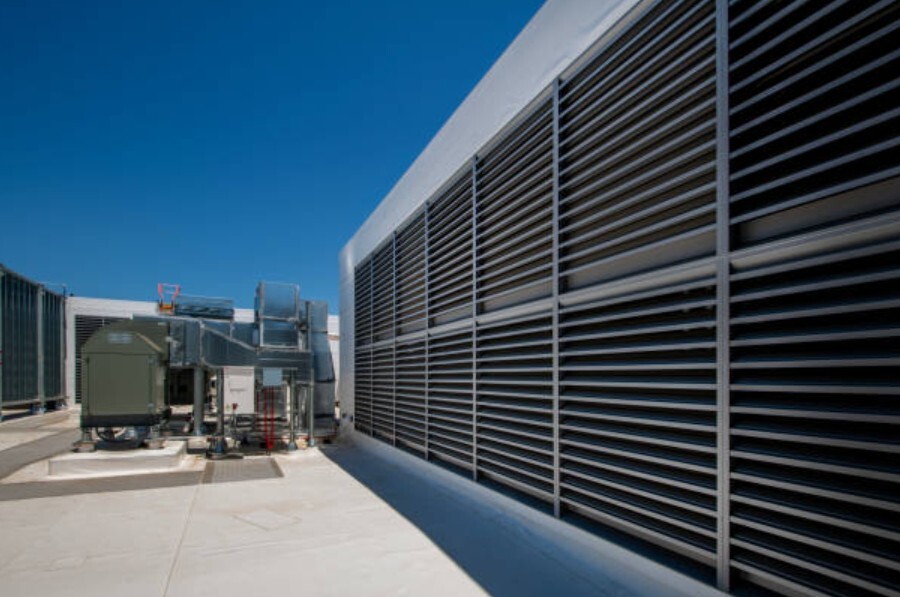
Exhaust Louvers: Airflow Solutions for Ventilation Needs
Effective ventilation starts at the discharge point. Exhaust louvers guide air out of the system while shielding the opening from weather and backdraft. Their engineered blades balance airflow and protection so mechanical systems stay efficient and sealed over time.
How Exhaust Louvers Control Airflow and Prevent Backdraft or Moisture Entry
Exhaust louvers regulate how air exits a building while blocking unwanted intrusion from the outside. Their blades create channels that deflect water and debris away from the opening yet maintain free area for air movement. When specified correctly, they form a pressure-balanced interface between the interior duct or fan system and outdoor conditions.
In HVAC and ventilation systems, a louvered exhaust section is typically mounted in exterior walls, mechanical-room partitions, or rooftop penthouses. The design ensures that outgoing air travels smoothly to the atmosphere without drawing moisture or dust back through the aperture. Paired with a backdraft damper or used on its own, the louver’s primary role stays the same: providing efficient discharge under varying static pressures.
How Louvers Manage Airflow and Protection
Each louver’s geometry controls both airflow direction and weather defense. Blade angle, spacing, and depth determine the ratio between open area and aerodynamic resistance. A deeper blade with tighter spacing offers stronger rain rejection but slightly higher pressure drop, while a shallower design maximizes free area for lower-velocity exhaust.
During operation, discharge air passes through the blades at design velocities often selected in the mid-hundreds to low-thousands of fpm, where aerodynamic effects help shed water. Models tested in accordance with AMCA 500-L Water Penetration standards quantify this performance, providing data engineers can use to size the correct unit for expected airflow rates.
Horizontal and Vertical Blade Configurations
Exhaust louvers come in two primary orientations, horizontal and vertical.
- Horizontal-blade louvers are the most common for wall-mounted exhaust points. Their overlapping profile directs water downward and away from the wall face while maintaining a uniform façade appearance.
- Vertical-blade louvers channel runoff more effectively under high-wind or wind-driven-rain conditions. They are often used in areas with frequent storms or for high-velocity air exhaust louvers where water rejection takes priority over maximum free area.
Some assemblies combine both blade types in a hybrid configuration. A vertical front section captures rain, while a horizontal rear bank promotes airflow uniformity. This arrangement yields balanced performance for coastal or high-exposure installations where both drainage and flow stability are critical.
Backdraft Dampers and Integrated Assemblies
When a fan shuts off, pressure equalizes and outdoor air can reverse flow into the duct system. Backdraft dampers prevent that reversal. In an aluminium louver for exhaust fan application, spring- or gravity-operated blades close automatically when the fan stops, sealing the opening against infiltration.
Many commercial assemblies integrate the damper directly behind the louver frame, creating a single engineered unit that simplifies installation. Properly aligned, the damper blades do not obstruct exhaust flow during operation yet close fully when airflow ceases. Air Performance manufactures models with precision-balanced aluminum blades and corrosion-resistant hardware to maintain long-term sealing integrity under continuous cycling.
Material and Finish Options
Selecting the right construction and coating defines how an air exhaust louver performs over time. Material strength, corrosion resistance, and finish durability all influence service life in demanding environments.
Aluminum for Corrosion Resistance
Performance begins with the frame and blade material. Most commercial air exhaust louvers are fabricated from extruded aluminum for strength, low weight, and resistance to oxidation. These properties make aluminum ideal for humid or coastal environments, mechanical penthouses, and rooftop installations exposed to constant weather.
Architectural Finishes and Coatings
Architectural projects often specify factory-applied finishes, most commonly baked enamel or polyester powder coating, to match façade colors while providing an added corrosion barrier. Each coating system is tested for adhesion and UV stability to maintain long-term performance in exterior exposure.
Drainable-Blade Construction for Moisture Management
Drainable-blade designs may include integrated gutters and weep channels that direct collected water away from the opening. This combination of material choice, finish, and drainage detail determines not only appearance but also how effectively the louver performs under high-rainfall or industrial-exhaust conditions.
Typical Applications of Exhaust Louvers
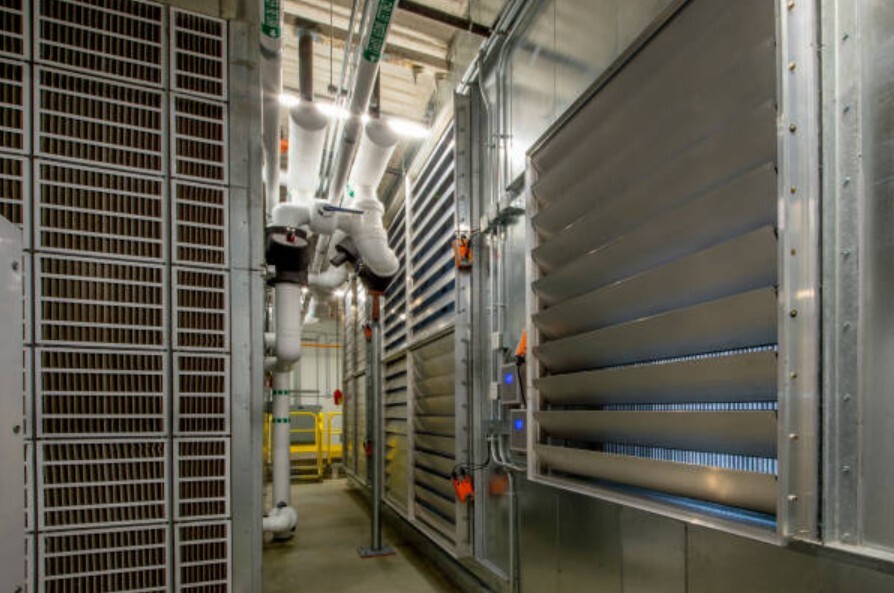
Exhaust louvers appear anywhere air must exit a conditioned space without compromising the envelope. Typical installations include:
- Mechanical rooms and penthouses – fans discharge through wall or rooftop openings.
- Equipment enclosures and generator rooms – heat and fumes require controlled release.
- Industrial facilities – exhaust systems handle higher particulate or chemical loads.
In these locations, louvers serve as both mechanical and architectural components. They maintain a clean exterior profile while guarding internal components from moisture or debris infiltration. When paired with an exhaust-fan assembly, the louver’s free-area and pressure-drop values are coordinated to maintain required system airflow and minimize static losses.
Performance and Compliance
Measured airflow data and verified standards separate engineered louvers from simple vent covers. Testing, selection, and certification together define how each model performs in service.
AMCA Testing and Performance Data
All Air Performance louvers are tested in accordance with AMCA 500-L for air performance and water penetration. These procedures provide consistent data for free area, pressure drop, and rain resistance at specific face velocities. Designers use these results to size openings precisely and keep system efficiency consistent.
For wind-exposed projects, review AMCA 500-L Wind-Driven Rain ratings—3 in/hr @ ≈ 29 mph and extended 8 in/hr @ ≈ 50 mph—to match site conditions.
Engineering Selection Criteria
A properly selected louvered exhaust maintains low pressure drop and demonstrates a beginning point of water penetration ≥ 800 fpm per AMCA 500-L, depending on model configuration. For wind-exposed sites, select models with appropriate Wind-Driven Rain effectiveness ratings. Air Performance engineers evaluate each specification against airflow rate, velocity pressure, and exposure level to determine the correct blade depth and spacing for each installation.
Code and Standard Compliance
Compliance extends beyond AMCA testing. Where assemblies penetrate rated barriers or form part of smoke control, coordinate UL-listed fire/smoke dampers with the louver to comply with NFPA 90A and applicable IBC provisions. Corrosion-resistant coatings comply with AAMA 2604/2605 standards for exterior durability. Together, these certifications show that each Air Performance louver functions as a tested, engineered component of a building’s mechanical safety and performance system.
Specify Air Performance Exhaust Louvers for Reliable Ventilation Control
Air Performance manufactures a full range of stationary and drainable louvers tested to meet AMCA 500-L requirements. Each model is engineered for efficient airflow, water resistance, and architectural integration in commercial and industrial applications. Contact our team today for project support or specification guidance.