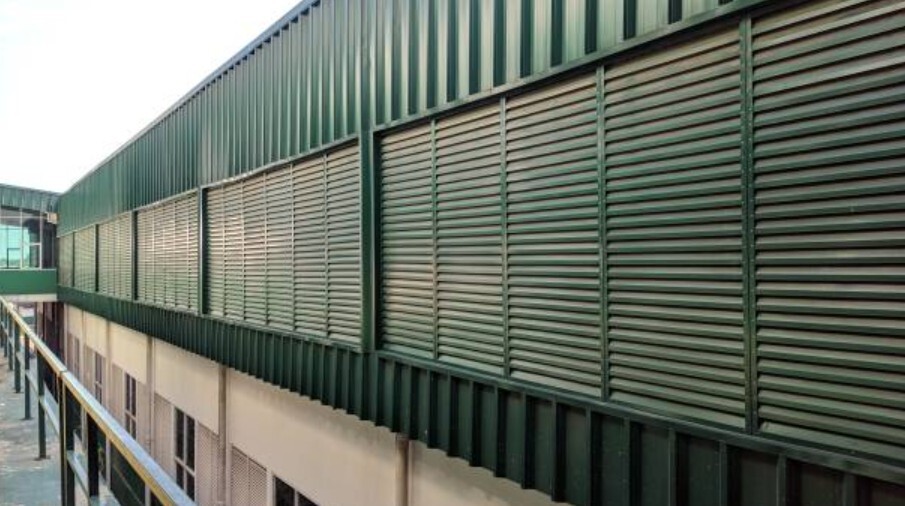
Adjustable Louvers: Functionality and Installation Guide
Airflow drives HVAC performance. Designers need components that not only protect building openings but also allow systems to regulate intake and exhaust precisely. Engineered with field-adjustable blades, adjustable louvers give HVAC systems that control, balancing airflow, weather defense, and energy efficiency under changing conditions.
What Are Adjustable Louvers?
Think of adjustable louvers as framed banks of blades that pivot together to open up, throttle back, or shed weather at the face. In the full-open position, they preserve free area and keep pressure drop in check. At intermediate angles, they shape the stream and interrupt wind-driven rain. Fixed louvers hold one angle forever; these don’t. That’s the point.
How They Work
Each blade in a movable-blade louver pivots on an axis and connects to a common operator, ensuring all blades move together. By changing blade position, the free area opens or closes, directly regulating how much air the HVAC system pulls in or exhausts. Fully open, they minimize resistance and maximize airflow; partially closed, they restrict flow and provide weather defense — a simple but effective method of controlling system ventilation.
Why They Matter
The value of operable louvers comes from more than their moving blades; it lies in how they let HVAC systems actively manage airflow while still protecting equipment and conserving energy.
Airflow Control at the System Level
Control is the leading benefit. These louver units give HVAC systems the ability to meter how much air passes through exterior walls or mechanical penthouses, keeping intake and exhaust aligned with demand. A small blade adjustment can stabilize indoor conditions, reduce drafts, and prevent equipment from overworking.
Weather and Energy Performance
Weather defense comes as a direct extension of that airflow regulation. By angling the blades, the assembly still admits necessary airflow while interrupting wind-driven rain and airborne debris before they reach ducts or fans. This balance between ventilation and protection allows systems to maintain airflow without sacrificing reliability.
Energy performance also ties back to airflow control. When louvers maintain sufficient free area and reduce unnecessary pressure resistance, fans consume less power to move the same volume of air. That efficiency lowers utility costs and extends the service life of HVAC equipment — practical gains made possible by a simple, controllable mechanism at the building envelope.
Performance Metrics
The performance of adjustable louvers depends on both measurable airflow data and how different project stakeholders evaluate those results.
Free Area and Pressure Loss
Free area is the open portion of the louver face through which air can pass, expressed as a percentage of the frame opening. Lower resistance at the same free area typically means lower fan energy. Still, the right blade angle under weather can justify a bit more pressure drop to protect equipment behind the intake.
Designers should also size louvers so free-area velocity remains below the beginning point of water penetration for the given exposure. Many models begin penetration around 1,100–1,200 fpm in lab tests, and exceeding that velocity can compromise weather protection.
Stakeholder Priorities
Architects tend to focus on airflow targets and exposure conditions. They evaluate free area, pressure-loss characteristics, and water-penetration performance to confirm the louver will meet spec. Contractors, by contrast, care about what happens on the wall: how the frame is positioned, anchored, and sealed to prevent leakage. Facility managers view the same equipment in terms of long-term reliability, checking how easily blades can be cycled or serviced, and what role the assembly plays in overall energy management.
Installation Basics: Step-by-Step

Proper installation is what ensures louvers meet the performance promised in submittals. Before anchoring any frame, the sequence must be clear so airflow control, sealing, and long-term reliability aren’t compromised. Louvers should also remain in their shipping crates until installation to prevent accidental damage, and all handling should protect finishes and blade alignment.
- Receive, inspect, and protect finishes. Keep units protected until you’re ready to set them. Inspect on receipt—visible and concealed damage—then handle with non-marring slings. Don’t drag frames on the slab.
- Prepare the opening and dry-fit. Confirm blade and weather orientation, set the frame, and verify plumb, level, and square. Shim before you ever drill. Square it first.
- Anchor by substrate. Choose anchors for the actual wall—concrete, CMU, steel, or framed. Follow the submittal for pattern and spacing; typical fastener spacing is 6 inches near corners and 12 inches on centers, adjusted by substrate. Verify embedment depth and edge distances.
- Assemble multi-section arrays. Set the first section, then join neighbors with bolted mullions or splice plates. Keep faces flush, tighten in sequence, and check that blades track together across joints. If alignment drifts, blade travel suffers.
- Seal perimeter and joints. After anchoring, install closed-cell backer rod where appropriate and apply compatible sealant around the frame. Seal mullion and stack joints on multi-section arrays. Air bypass is wasted fan power.
- Sleeves, channels, and high-wind models. Using a sleeve or channel frame—or an impact or hurricane model? Follow the model-specific instructions and approval drawings for fastener type, pattern, and clearances. Those details aren’t suggestions.
- Accessories and connections. Install bird or insect screens per instructions—never lift by the screens. If a duct, fan, or damper ties in, support it from the structure, not the louver. Then seal the joint.
- Operator and actuator check. Cycle blades from fully open to fully closed. Look for binding and full travel. With electric actuators, have qualified personnel wire and commission to the documented range and end stops.
- Weatherproofing trim and final sealant. Install required flashing or trim and re-check continuity of every sealant joint. Water finds gaps. So will your punch list.
- Clean and closeout. Wipe finished surfaces with non-abrasive methods. Record model data and any field deviations in the O&M. That note saves time later.
Maintenance Considerations
These ventilation louvers are mechanical devices, and like any mechanism they need periodic care. Plan quarterly checks: cycle blades, confirm hardware torque, wipe debris, and spot-lube per manufacturer guidance. In harsher environments—coastal salt, industrial particulates—shorten the interval. Small habits keep motion smooth and pressure loss predictable. Over a long service life, that’s meaningful energy savings.
Controls and Automation
Controls matter as well. Manual quadrants suit static setpoints; electric or pneumatic actuators tie into automation for schedules, differential pressure, or weather inputs. During commissioning, confirm fail positions and signal ranges so blades travel cleanly without chatter or over-torque. For facilities pursuing demand-based ventilation, adjustable louvers provide the front-end modulation that helps automation systems keep fan energy in check while maintaining weather defense at the wall.
Materials and Environmental Factors
Material selection depends on site conditions. Coastal corrosion, industrial chemistry, or urban grime each push you toward specific alloys and coatings—aluminum with durable finishes in many cases; stainless where exposure demands it. Finishes protect performance as much as appearance. Even so, the best coating can’t make up for poor installation. Match materials and sealants to the substrate, and the assembly will reward you with predictable operation.
Field Pitfalls to Avoid
Common pitfalls include frames installed out of square, incomplete perimeter sealing, or loads transferred from ductwork directly to the louver frame. Short pre-installation meetings help align responsibilities and prevent rework. Once properly squared, sealed, and anchored, the louver will perform as intended—providing airflow where needed and keeping weather outside.
Troubleshooting Common Issues
Blade binding often traces back to an out-of-square opening. Sealant shrinkage or omission can cause leaks. Actuators wired incorrectly may leave blades off their full travel. Screens clogged with debris can reduce airflow. Quick checks in each of these areas typically resolve most post-installation complaints without major rework.
Specify Air Performance Adjustable Louvers for HVAC Reliability
Air Performance LLC supplies adjustable louvers engineered for HVAC systems that demand airflow control, durability, and reliable performance in all conditions. Each unit is tested to defined criteria so architects can specify confidently and contractors can install without delays. Contact us today for more information.