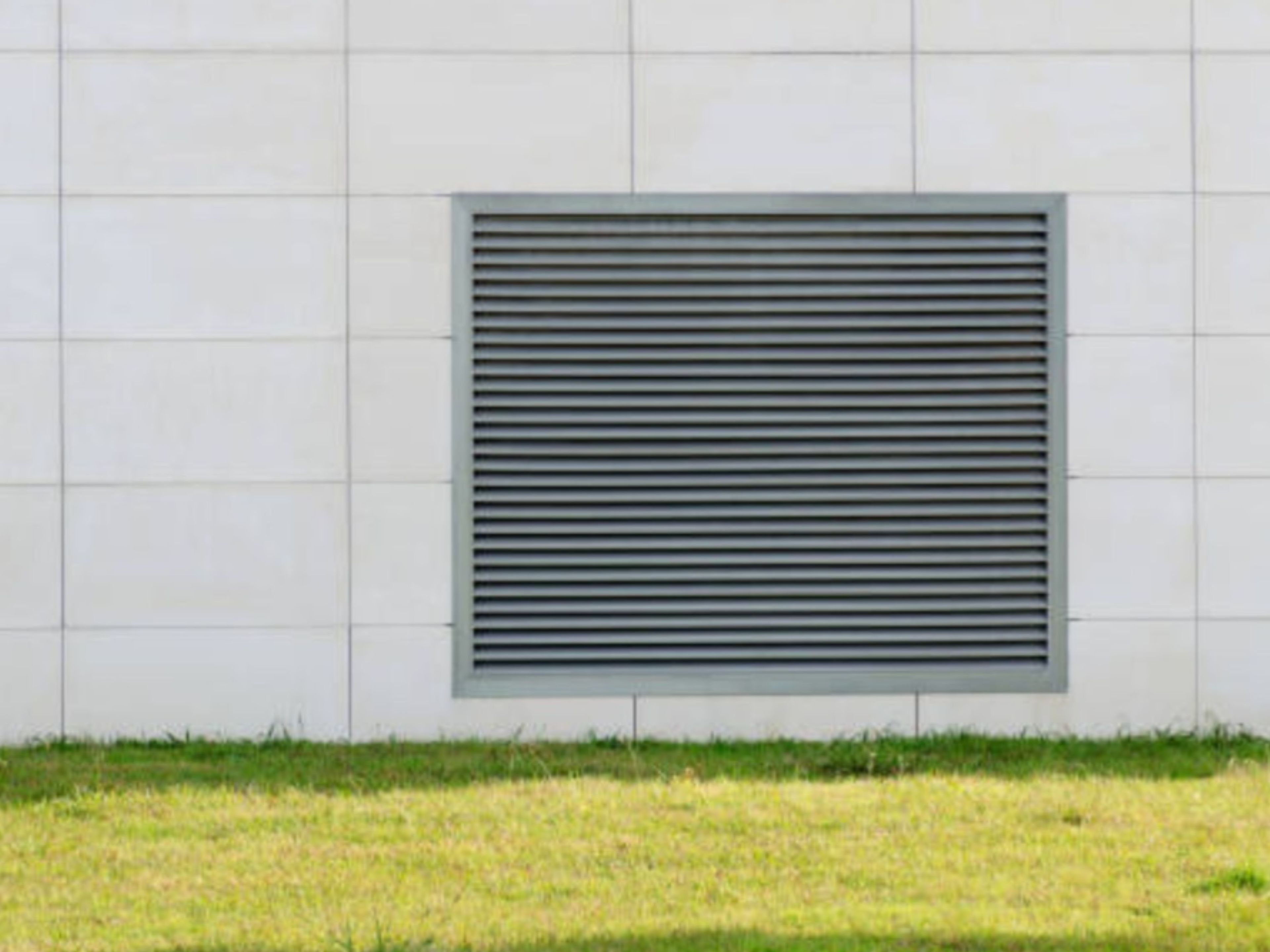
Ventilation Louvers: Types, Design, and Manufacturers
Ventilation louvers control airflow while protecting buildings from rain and debris. They allow outside air to move freely through mechanical openings without compromising pressure balance or interior conditions. Air Performance engineers these assemblies for consistent airflow, durable construction, and reliable water management in façades, rooftop penthouses, and mechanical intakes.
What Are Ventilation Louvers?
A ventilation louver directs air through angled blades built into a rigid frame. Blade geometry determines both free area and how effectively water is shed. Engineers size each unit for airflow rate, pressure, and exposure. These openings appear in walls, generator housings, or rooftop screens. When selected and tested correctly, they keep water out and maintain stable airflow under real-world wind loads.
Mechanical vs. Architectural Louvers
Mechanical louvers prioritize performance, airflow, pressure, and weather defense, while architectural louvers emphasize façade uniformity. Many commercial systems prefer mechanical louvers for verified airflow data and AMCA compliance. Together, they form the ventilation envelope that balances appearance and tested performance.
Common Types of Ventilation Louvers
Selection depends on airflow requirements, weather exposure, and application.
Fixed Louvers
Fixed designs use stationary blades at a set angle. Because they have no moving parts, they run year-round with minimal maintenance. Their predictable free area makes airflow calculations straightforward, and AMCA 500-L testing verifies air performance and water-penetration limits. Engineers rely on them when consistent ventilation matters more than control.
Adjustable Louvers
Adjustable designs add flexibility. Their blades pivot manually or by actuator, giving operators the option to modulate airflow or shut completely during storms or service. These adjustable ventilation louvers are used in mechanical rooms and large AHUs requiring variable operation. As blade angles change, airflow behavior shifts, performance data must show that. Engineers expect those curves. Proper linkage keeps motion uniform and limits leakage when closed. On installs, that detail separates a reliable assembly from one that drifts out of alignment.
Combination Louvers
Some projects need both control and protection. Combination louvers merge a fixed outer bank with adjustable inner blades. The exterior deflects rain; the interior manages air volume. That single frame saves wall space and reduces leak paths—a design that specifiers appreciate. It also preserves façade continuity when both intake and exhaust share the same elevation.
Storm-Resistant Louvers
When weather exposure intensifies, storm-resistant models provide another level of defense. These assemblies use deeper blade profiles, tighter spacing, and reinforced frames to resist wind-driven rain at hurricane-level velocities. Many are tested under AMCA 550, UL, or Miami-Dade protocols to prove performance in coastal or high-wind regions. They maintain airflow while directing water outward through drains to minimize intrusion.
Sand-Trap Louvers
Sand-trap louvers serve environments where airborne dust or fine particles threaten equipment. Each unit incorporates slotted blades and collection chambers that separate heavier particles before the airstream continues downstream. The design helps protect filters and fans in arid or desert installations such as power plants, refineries, and data centers. Routine cleaning of the chamber base is simple but essential for reliable airflow.
Architectural and Hidden Louvers
Architectural louvers deliver airflow requirements, while also being integrated within the facade or building design. Preserving visual uniformity on facades and storefronts. Architects often pair them with other material applications and with custom finishes, so ventilation occurs without disrupting exterior design lines.
Equipment Screens
Equipment screens extend the same blade profiles used in ventilation louvers across mechanical penthouses or rooftop enclosures. They conceal equipment while allowing full airflow, helping projects meet aesthetic requirements without restricting performance. Air Performance fabricates these assemblies to match surrounding louvers for consistent appearance and airflow management.
Acoustic Louvers
Noise-sensitive facilities turn to acoustic models. These units pack sound-absorbing baffles inside aerodynamic blade shapes to quiet mechanical or generator noise. Each blade carries perforated liners and mineral fill that absorb targeted frequencies while letting air move. Acoustic louvers are tested for transmission loss under ASTM E90. Hospitals, data centers, laboratories, and power facilities use them to keep systems ventilated without adding decibels.
Key Design Considerations
Designing ventilation louvers is about balance, free area, velocity, and pressure control working together. In practice, that balance decides whether an air handler meets spec or fights back-pressure. A larger free area lowers static pressure, yet blades must still overlap to block wind-driven rain. AMCA 500-L testing quantifies that relationship so comparisons stay accurate across manufacturers.
Free Area and Air Velocity
Specifiers review pressure-drop curves at several face velocities to right-size the opening. Keeping velocity through the free area near 800–1,200 fpm typically preserves energy efficiency and limits entrainment; higher velocities may require larger frames or multiple sections. Submittals should include tested pressure-drop tables so AHU and duct layouts stay aligned.
Water Penetration and Drainage
Water control deserves equal focus. During storms, louvers take on both air and water load. Good blade geometry and drain paths pull moisture out of the airstream before it reaches the wall. AMCA tests define when water starts to penetrate and at what airflow velocity. For exterior walls, a low penetration point keeps insulation and downstream gear dry.
Filtration and Automation Integration
Ventilation systems often connect louvers to filtration and building-automation equipment. Some louvers integrate filter racks, insect screens, or dampers directly within the frame to save space. In larger installations, actuators tie into building-management systems (BMS) for automated control based on temperature, static pressure, or occupancy. That integration allows continuous airflow optimization while still protecting against weather intrusion.
Material and Finish Selection
Material and finish drive long-term durability. Aluminum dominates because it’s light, corrosion-resistant, and easy to form into complex profiles. Steel versions handle impact or high-pressure zones. Finishes extend service life and appearance—powder-coat or anodize systems tested to AAMA 2605 withstand UV, salt, and chemicals.
High-quality coatings and controlled fabrication support long service life and warranty performance, when properly maintained, reducing replacement and maintenance costs over time. In coastal plants, that coating difference shows up years later in maintenance budgets. Composite options are emerging for niche uses, offering a balance of corrosion resistance and strength where metal exposure is limited.
Specify Air Performance Louvers for Tested Airflow and Weather Protection
Air Performance engineers AMCA-tested louvers for commercial and industrial projects that demand reliable airflow control and moisture resistance. Each model is delivered with documented performance data, submittal support, and finish coordination options. Contact us today for more information.